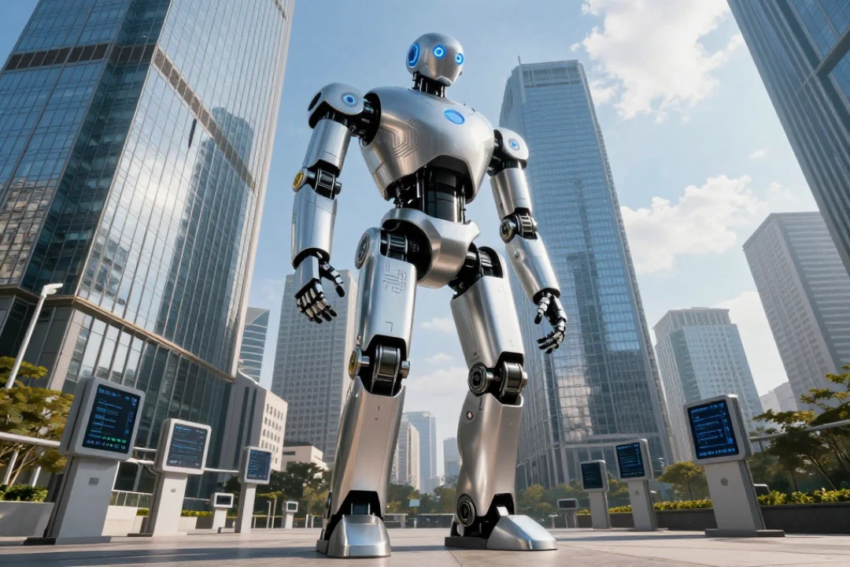
Artificial Intelligence, commonly known as AI, has become one of the most influential technologies of the twenty-first century. Machines that can learn, analyze information, recognize patterns, understand human language, and generate content are no longer ideas limited to science-fiction stories. They are increasingly becoming part of everyday life.
From smartphones and search engines to hospitals, schools, banks, factories, and transportation systems, AI is changing how people live and work. Businesses use AI to understand customers and automate tasks. Doctors use AI-assisted systems to analyze medical information. Students use intelligent tools to learn and research. Scientists use AI to process enormous datasets and explore complex problems.
The rise of AI technology is not simply another step in the development of computers. It represents a major shift in how humans interact with machines. Traditional computers were generally designed to follow instructions written by people. Modern AI systems can learn patterns from data and perform tasks that previously required significant human effort.
This transformation brings enormous opportunities, but it also creates important challenges. Questions about employment, privacy, misinformation, security, fairness, and human responsibility are becoming increasingly important. Understanding the rise of AI is therefore essential for understanding the future of society.
What Is Artificial Intelligence?
Artificial Intelligence is a field of technology focused on developing computer systems that can perform tasks associated with human intelligence.
These tasks may include recognizing images, understanding language, analyzing data, solving problems, making predictions, and generating content.
One of the key technologies behind modern AI is machine learning. Instead of requiring programmers to provide instructions for every possible situation, machine-learning systems can learn patterns from examples.
For instance, an AI system can be trained using many examples of photographs. By analyzing these examples, the system can learn to recognize patterns associated with particular objects.
Another important technology is natural language processing, which allows computers to understand and generate human language. This technology is used in translation systems, voice assistants, chatbots, search engines, and AI writing tools.
Together, these technologies have made AI increasingly useful across different industries.
The Evolution of AI
The idea of intelligent machines is not new. Scientists and philosophers have imagined artificial intelligence for centuries.
Modern AI research began developing significantly during the twentieth century as computers became more powerful.
Early AI systems were relatively limited. They often relied on rules created by programmers and could perform specific tasks under controlled conditions.
The development of more powerful computers, larger datasets, and improved algorithms eventually allowed machine learning to become much more effective.
The growth of the internet also contributed significantly. Digital systems began producing enormous amounts of data, giving AI researchers more information from which machines could learn.
Today, AI systems can perform tasks that would have seemed remarkable only a few decades ago.
AI in Everyday Life
Many people interact with AI every day without thinking about it.
Smartphones use AI for features such as voice recognition, image processing, spam filtering, and personalized recommendations.
Online services use AI algorithms to recommend videos, music, products, and other content.
Email platforms can automatically identify unwanted messages.
Navigation systems analyze traffic information to recommend routes.
Banks use automated systems to detect unusual financial activity.
These examples demonstrate that AI is already deeply integrated into modern society.
The technology often works quietly in the background, making it easy to overlook its influence.
AI and Healthcare
Healthcare is one of the most important areas where AI is creating new possibilities.
Medical professionals have access to enormous amounts of information, including medical records, laboratory results, scans, genetic data, and scientific research.
AI can help process this information and identify patterns.
For example, AI-assisted systems can help healthcare professionals analyze medical images and identify suspicious areas. AI can also support drug discovery by helping researchers analyze chemical and biological information.
Hospitals may use AI for administrative tasks such as scheduling, documentation, and information management.
Wearable devices can collect information about activity, heart rate, sleep, and other measurements. AI can analyze these data streams and potentially identify unusual patterns.
However, medical AI must be used carefully. Human professionals remain essential for interpreting information, communicating with patients, and making appropriate medical decisions.
AI and Education
Education is also being transformed by intelligent technologies.
AI can provide students with personalized explanations and learning resources. Students can use AI tools to explore difficult concepts, practice languages, generate study questions, and receive feedback.
Teachers can use AI to organize information, prepare learning materials, analyze student performance, and reduce certain administrative tasks.
The ability to personalize learning is particularly valuable because students have different abilities and learning speeds.
However, there are risks. Students who rely too heavily on AI may stop developing important skills such as independent research, critical thinking, writing, and problem-solving.
Schools therefore need to teach students how to use AI responsibly rather than simply banning or blindly accepting it.
AI and Business
Businesses are rapidly adopting AI technology.
Companies can use AI to analyze customer behavior, forecast demand, automate repetitive processes, and improve decision-making.
Customer-service chatbots can answer common questions at any time. AI can also help employees search through large collections of documents and information.
Marketing departments can use AI to identify customer trends and personalize certain forms of communication.
Manufacturing companies can use AI to monitor equipment and identify potential problems before they become serious.
These applications can increase productivity and reduce the time required for certain tasks.
As AI becomes more widespread, businesses that learn to use it effectively may gain significant advantages.
AI and Transportation
Transportation is another field being changed by AI.
Modern vehicles increasingly contain intelligent driver-assistance systems. These systems may help with tasks such as maintaining lanes, detecting nearby objects, assisting with parking, and applying emergency braking.
AI is also used in navigation and traffic-management systems.
Researchers are developing increasingly automated vehicles that can perform more driving tasks with limited human involvement.
If these technologies become sufficiently reliable, they could potentially change how people travel and how goods are transported.
However, transportation systems involve serious safety concerns. Autonomous vehicles must be carefully tested, and questions about responsibility and regulation must be addressed.
AI in Manufacturing
Factories have used automation for many years, but AI is making industrial systems more intelligent.
Traditional machines generally perform predetermined tasks. AI-powered systems can analyze information from sensors and adjust operations based on changing conditions.
Robotic systems can perform repetitive tasks with high consistency.
AI can also support predictive maintenance. Instead of waiting for a machine to fail, an AI system can analyze sensor data and identify patterns that may indicate an upcoming problem.
This can help companies reduce downtime and improve efficiency.
However, automation may also change the types of jobs available in manufacturing, making worker training increasingly important.
AI and Scientific Discovery
AI is becoming an important tool for scientific research.
Modern experiments can generate enormous quantities of data. Researchers may struggle to analyze all of it manually.
AI can identify patterns and relationships within large datasets, helping scientists develop new hypotheses.
In biology, AI can help researchers study genes, proteins, and diseases.
In astronomy, it can analyze data from telescopes and identify objects or patterns.
In environmental science, AI can help researchers study weather, ecosystems, and environmental changes.
The ability to process large amounts of information quickly could accelerate scientific discovery.
AI and Creativity
AI is also changing creative industries.
Modern AI systems can generate text, images, music, video, and other forms of content.
Writers can use AI to brainstorm ideas or create drafts. Designers can explore visual concepts. Musicians can experiment with new sounds. Filmmakers may use AI-assisted tools during production.
However, AI-generated content also raises difficult questions.
Who owns an AI-generated work? How should creators whose work contributed to training datasets be treated? How can people distinguish between authentic human-created content and synthetic media?
These questions are still developing as technology advances.
The Changing World of Work
One of the most significant effects of AI may be its impact on employment.
AI can automate repetitive tasks and potentially change the responsibilities associated with many jobs.
Some jobs may decline as certain tasks become automated, while new occupations may emerge.
For example, organizations need people who can develop, manage, test, monitor, and govern AI systems.
The future workplace will likely require a combination of technical and human skills.
Critical thinking, creativity, communication, leadership, adaptability, and emotional intelligence may become increasingly valuable because these abilities are difficult to automate completely.
Education and professional training will need to evolve to prepare people for this changing environment.
AI and Human Productivity
AI can significantly increase human productivity.
A person who previously needed several hours to analyze information may be able to complete certain parts of the task much faster with AI assistance.
Employees can use AI to summarize documents, organize information, generate initial drafts, analyze data, and automate repetitive processes.
This can allow people to spend more time on complex and creative activities.
However, productivity improvements depend on how AI is used. Poorly designed or inaccurate AI systems can create additional work rather than reduce it.
Organizations therefore need to train employees and establish effective systems for reviewing AI-generated results.
Privacy Concerns
The rise of AI also creates concerns about personal privacy.
AI systems often depend on large quantities of data. This data may include information about people’s behavior, preferences, locations, communications, purchases, or health.
Organizations need to protect personal information and use it responsibly.
People should also understand that the convenience offered by intelligent services can sometimes involve the collection and processing of significant amounts of information.
Privacy protection will therefore remain an important part of AI development.
Misinformation and Deepfakes
AI can generate highly realistic text, images, audio, and video.
This technology has positive applications, but it can also be misused.
AI-generated fake content can spread misinformation and make it more difficult for people to determine whether something is genuine.
Deepfake technology can create realistic-looking videos or audio recordings of people saying or doing things that never happened.
This creates challenges for journalism, politics, education, businesses, and ordinary individuals.
As AI-generated content becomes more convincing, digital literacy and reliable methods of verifying information will become increasingly important.
Ethical Challenges
The rise of AI raises several ethical questions.
One concern is algorithmic bias. If an AI system learns from biased data, its results may also be biased.
Another concern is accountability. When an AI system makes an important decision, it may be difficult to determine who is responsible for the outcome.
There are also concerns about transparency. Some AI systems are complex and difficult to explain.
Responsible AI development therefore requires clear standards involving fairness, safety, privacy, transparency, and accountability.
The Future of AI
AI technology will probably continue to develop rapidly.
Future AI systems may become better at understanding complex information, working across different types of data, assisting scientific research, and interacting with people.
AI could contribute to solving major global problems, including disease, environmental challenges, food production, and resource management.
However, the future will not be determined by technology alone. Society must decide how AI should be used.
Governments may need appropriate regulations. Businesses will need responsible policies. Educational institutions will need to teach AI literacy. Individuals will need to develop the ability to evaluate AI-generated information critically.
The most successful future is likely to be one in which humans and machines work together.
Humans and Machines Working Together
The rise of AI does not necessarily mean the end of human intelligence or creativity.
Machines have strengths that humans do not. They can process enormous quantities of information quickly and perform repetitive calculations consistently.
Humans have strengths that machines do not possess in the same way. People can understand emotions, build relationships, make moral judgments, and respond creatively to unexpected situations.
The combination of these abilities can be extremely powerful.
For example, a doctor can use AI to analyze medical information but rely on professional judgment to communicate with a patient and decide how best to proceed.
A teacher can use AI to create educational resources while providing personal guidance to students.
A scientist can use AI to analyze data while deciding which questions deserve further investigation.
This partnership between human intelligence and artificial intelligence may define the next stage of technological development.
Conclusion
The rise of AI technology is changing the world in ways that affect almost every part of modern life. AI is transforming healthcare, education, business, transportation, manufacturing, scientific research, communication, and creative work.
Its ability to analyze data, recognize patterns, automate tasks, and generate content provides enormous opportunities. It can improve productivity, support scientific discovery, personalize services, and help people solve complex problems.
At the same time, AI creates serious challenges involving employment, privacy, misinformation, bias, security, and accountability.
The answer is not to reject AI, nor is it to accept every new AI system without question. Society needs a balanced approach that encourages innovation while protecting people.
The future of AI should be built around human needs and values. Technology should help people rather than undermine their freedom, privacy, safety, or dignity.
Ultimately, the rise of AI is not simply about smarter machines. It is about how humanity chooses to use those machines.
If AI is developed responsibly and combined with human creativity, judgment, and compassion, it can become one of the most powerful tools for improving life and building a more innovative future.