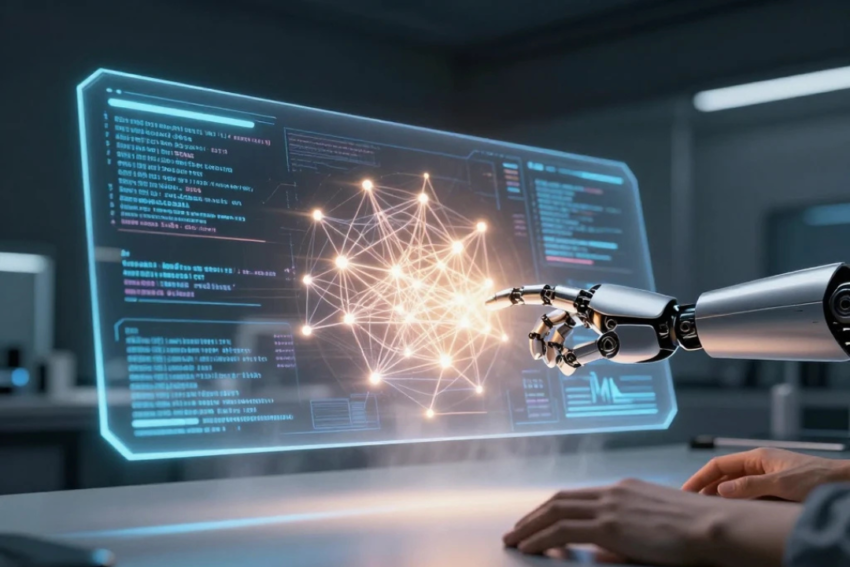
Artificial Intelligence, commonly known as AI, is one of the most significant technological developments of the modern era. Over the past few years, AI has moved from specialized research laboratories into everyday life. People now interact with AI through smartphones, search engines, recommendation systems, virtual assistants, educational tools, healthcare technologies, business software, and content-generation applications.
The rapid development of AI has created excitement about what the future may bring. AI could help humanity solve difficult problems, improve healthcare, accelerate scientific research, increase productivity, and create new forms of education and communication. At the same time, the technology presents serious risks involving privacy, employment, misinformation, cybersecurity, bias, safety, and the misuse of powerful systems.
The future of Artificial Intelligence will therefore depend not only on how advanced the technology becomes but also on how responsibly humans develop and use it. AI can provide extraordinary opportunities, but these opportunities must be balanced with careful consideration of its risks.
Understanding Artificial Intelligence
Artificial Intelligence refers to computer systems that can perform tasks that traditionally require human intelligence. These tasks include learning from data, recognizing patterns, understanding language, solving problems, making predictions, and generating content.
Modern AI is supported by several technologies, including machine learning, deep learning, natural language processing, and computer vision.
Machine learning allows systems to learn patterns from data. Natural language processing enables computers to work with human language. Computer vision allows machines to analyze images and videos.
Generative AI represents another important development. These systems can create text, images, audio, video, software code, and other forms of content.
As computing power and data availability continue to increase, AI systems are becoming more capable and are being introduced into an increasing number of industries.
The Future of Healthcare
One of the greatest opportunities for AI lies in healthcare.
Medical professionals deal with enormous amounts of information. AI can help analyze medical images, laboratory results, patient records, and scientific research.
Future AI systems could provide doctors with more sophisticated decision-support tools. They may help identify patterns associated with diseases, assist in treatment planning, and monitor patients continuously.
AI could also accelerate drug discovery. Researchers can use intelligent systems to analyze chemical and biological information and identify potential drug candidates.
Personalized medicine may also benefit from AI. Instead of applying exactly the same approach to every patient, healthcare systems could increasingly use individual medical and biological information to support more personalized treatment strategies.
However, medical AI must be developed carefully. Incorrect recommendations could harm patients, and sensitive medical data must be protected.
AI and Education
AI could fundamentally change education.
Traditional education often provides similar material to groups of students even though students have different learning speeds and needs.
AI-powered educational systems could provide more personalized learning experiences. An intelligent tutor could explain a difficult concept in several different ways, provide practice questions, and adjust the difficulty based on a student’s performance.
Teachers could use AI to prepare lesson materials, organize information, provide certain forms of feedback, and reduce administrative work.
AI could also improve access to education by providing learning support to people in remote areas or to students who need additional assistance.
However, education must not become overly dependent on AI. Students still need to develop independent thinking, creativity, communication, and problem-solving skills.
AI and Scientific Discovery
Scientific research is another area where AI could have an enormous impact.
Modern scientific experiments generate huge amounts of data. AI can help researchers analyze this information and identify patterns.
In biology, AI can assist researchers in studying genes, proteins, and diseases.
In chemistry, it can help explore potential molecules and chemical reactions.
In astronomy, AI can analyze large collections of astronomical data.
In environmental science, AI can help researchers model complex systems and monitor changes in ecosystems.
By reducing the time required to analyze data, AI could allow scientists to investigate more possibilities and accelerate certain areas of discovery.
AI and the Future of Work
The impact of AI on employment is one of the most widely discussed aspects of its development.
AI can automate many repetitive and predictable tasks. This may increase productivity and allow workers to focus on more complex activities.
For example, AI can help employees summarize documents, analyze data, prepare reports, organize information, and handle routine customer-service requests.
However, automation may also reduce demand for certain tasks and potentially change or eliminate some jobs.
The effect will probably vary significantly between industries and occupations.
Some jobs may be heavily transformed, while others may experience relatively small changes. At the same time, new roles may emerge around AI development, management, testing, security, and governance.
The future workforce will likely need to learn how to work effectively with AI.
Skills such as critical thinking, creativity, communication, adaptability, leadership, and emotional intelligence may become increasingly valuable.
New Economic Opportunities
AI could create substantial economic opportunities.
Businesses can use AI to improve efficiency, develop new products, personalize services, and make better use of data.
Entrepreneurs may create new companies based on AI-powered services.
Industries that adopt AI effectively could increase productivity and develop innovative products.
AI may also reduce the cost of certain services, potentially making advanced capabilities available to more people.
However, the economic benefits of AI may not be distributed equally.
Large organizations with significant financial and technical resources may have advantages in developing and deploying advanced AI systems.
Governments and institutions may therefore need to consider policies that encourage innovation while ensuring that the benefits of technological progress are broadly shared.
AI and Creativity
AI is already changing creative work, and this trend is likely to continue.
Future AI systems may become increasingly capable of generating realistic images, music, video, writing, software, and other forms of content.
This could provide creators with powerful new tools.
A designer might use AI to explore hundreds of visual concepts quickly. A writer could use AI to brainstorm ideas. A filmmaker might use AI-assisted tools during production.
However, AI-generated creativity also raises difficult questions about copyright, ownership, originality, and the value of human-created work.
Society will need to determine how creators should be protected and how AI-generated content should be identified.
AI and Transportation
The future of transportation could also be shaped by AI.
Advanced driver-assistance systems already use intelligent technologies to monitor vehicles and surroundings.
Future autonomous vehicles may be capable of performing more driving tasks without direct human control.
AI could also improve traffic management by analyzing real-time information and adjusting transportation systems.
Autonomous delivery vehicles and other automated systems may become more common.
However, safety remains the most important consideration. Transportation technology must be tested extensively because failures can have serious consequences.
AI and Climate Change
AI could potentially contribute to efforts to address environmental challenges.
Climate and environmental systems are extremely complex. AI can analyze large datasets related to weather, energy consumption, ecosystems, and environmental conditions.
It may help researchers develop better climate models and identify patterns in environmental data.
AI can also support energy efficiency. Intelligent systems may help optimize electricity use in buildings, factories, and transportation networks.
In agriculture, AI could help farmers use water, fertilizers, and other resources more efficiently.
However, AI itself requires computing infrastructure and energy. The environmental impact of developing and operating large AI systems must therefore also be considered.
The Risk of Job Displacement
One of the most important risks associated with AI is job displacement.
When machines can perform tasks previously completed by humans, some workers may face reduced demand for their skills.
This does not necessarily mean that mass unemployment will occur, but it does mean that many occupations may change.
Workers may need to acquire new skills and adapt to new responsibilities.
Governments, educational institutions, and employers can play an important role by supporting retraining and lifelong learning.
The transition needs to be managed carefully so that technological progress does not create unnecessary economic hardship.
Privacy Risks
AI systems often depend on large quantities of data.
This can include information about people’s behavior, communication, location, health, financial activity, and personal preferences.
The more powerful AI becomes, the more valuable data may become.
This creates significant privacy concerns.
Organizations need to protect personal information and ensure that it is collected and used responsibly.
People should also have meaningful information about how their data is being used.
Strong privacy practices will be essential if society is to maintain public trust in AI.
Misinformation and Deepfakes
AI can generate highly realistic text, images, audio, and video.
This has many positive applications, but it can also be used to create misinformation.
Deepfake technology can produce realistic-looking videos or audio recordings that appear to show people saying or doing things that never happened.
Such technology could be used for fraud, manipulation, harassment, or the spread of false information.
As synthetic media becomes increasingly convincing, society will need better tools for authentication and verification.
People will also need stronger digital literacy skills so they can evaluate information critically.
AI Bias and Discrimination
AI systems can produce biased results if they are trained on biased or incomplete data.
This is particularly concerning when AI is used for decisions that affect people’s lives.
For example, biased systems could potentially produce unequal outcomes in employment, finance, education, or healthcare.
Developers need to test AI systems across different populations and identify potential sources of unfairness.
Fairness should be considered throughout the development process rather than treated as an afterthought.
Cybersecurity and Malicious Use
AI can be used to improve cybersecurity, but it can also be misused.
Defenders can use AI to identify suspicious activity and respond to threats.
At the same time, malicious actors may use AI to automate scams, generate deceptive content, or improve certain cyberattacks.
This creates an ongoing technological competition.
As AI becomes more powerful, cybersecurity systems will need to evolve alongside it.
The Risk of Overdependence
Another potential problem is excessive dependence on AI.
People may begin to rely on AI for decisions that they could previously make independently.
If individuals accept AI-generated information without checking it, mistakes can spread quickly.
Overdependence could also weaken skills such as writing, reasoning, research, and problem-solving.
The solution is not to avoid AI completely. Instead, people should learn when AI is useful and when human judgment is more appropriate.
The Need for Regulation
As AI becomes more powerful, governments and institutions will need appropriate rules.
Regulation can help address issues such as safety, privacy, discrimination, accountability, and transparency.
However, regulation must be carefully designed.
Rules that are too weak may fail to protect society from harmful applications. Rules that are unnecessarily restrictive could slow beneficial innovation.
The challenge is to create a balanced framework that encourages useful technological development while protecting people.
Human Control and Responsibility
One of the most important principles for the future of AI should be human responsibility.
AI systems may become increasingly capable, but humans remain responsible for deciding how those systems are used.
Important decisions affecting people’s health, rights, safety, and freedom should receive appropriate human oversight.
Organizations should also monitor AI systems after deployment rather than assuming that a system will always behave as expected.
Continuous testing, evaluation, and improvement will be necessary.
Building Trustworthy AI
For AI to become widely accepted, people need to trust it.
Trustworthy AI should be reliable, secure, fair, transparent, and respectful of privacy.
Users should understand what an AI system can and cannot do.
Organizations should be open about important limitations.
AI developers should also create systems that can be evaluated and monitored.
Trust should come from evidence and responsible practices rather than simply from claims that a system is intelligent.
The Future Relationship Between Humans and AI
The future is unlikely to be a simple competition between humans and machines.
Instead, AI may become a tool that extends human capabilities.
Machines are extremely good at processing large quantities of information and identifying patterns.
Humans are strong in areas such as empathy, moral reasoning, creativity, social understanding, and dealing with unpredictable situations.
Combining these strengths could produce better outcomes.
For example, doctors could use AI to analyze complex medical information while retaining responsibility for patient care.
Scientists could use AI to explore enormous datasets while deciding which discoveries are scientifically meaningful.
Teachers could use AI to personalize learning while continuing to provide human encouragement and guidance.
This human-AI partnership may define the future of many professions.
Conclusion
The future of Artificial Intelligence offers both extraordinary opportunities and serious risks.
AI could improve healthcare, education, scientific research, transportation, business, environmental management, and countless other areas. It could increase productivity, accelerate discovery, personalize services, and help people solve problems that are difficult to address using traditional methods.
At the same time, AI creates challenges involving employment, privacy, misinformation, bias, cybersecurity, safety, and overdependence on technology.
The answer is neither to fear AI nor to accept it without question. Society needs a balanced approach that encourages innovation while protecting people.
The future of AI will ultimately be shaped by human choices. Technology itself does not determine whether the future will be better or worse. The decisions made by developers, businesses, governments, educators, and individuals will determine how AI affects society.
Artificial Intelligence should be developed with human values at its center. Privacy, fairness, safety, transparency, accountability, and human dignity must remain important principles.
If these principles guide the development of AI, the technology can become a powerful partner in building a better future. The greatest opportunity is not for machines to replace humanity, but for humans to use intelligent technology to expand knowledge, improve lives, and address some of the world’s greatest challenges.
The future of Artificial Intelligence is therefore not simply about what machines will be able to do. It is about what humanity will choose to do with them.