Introduction
Communication is one of the most important abilities in human life. Speaking allows people to express their thoughts, emotions, needs, opinions, and relationships with others. However, certain neurological diseases and injuries can take away a person’s ability to speak even when their ability to think and understand remains intact. For people living with conditions such as amyotrophic lateral sclerosis (ALS), stroke, or severe paralysis, losing speech can lead to frustration, social isolation, and a major reduction in independence.
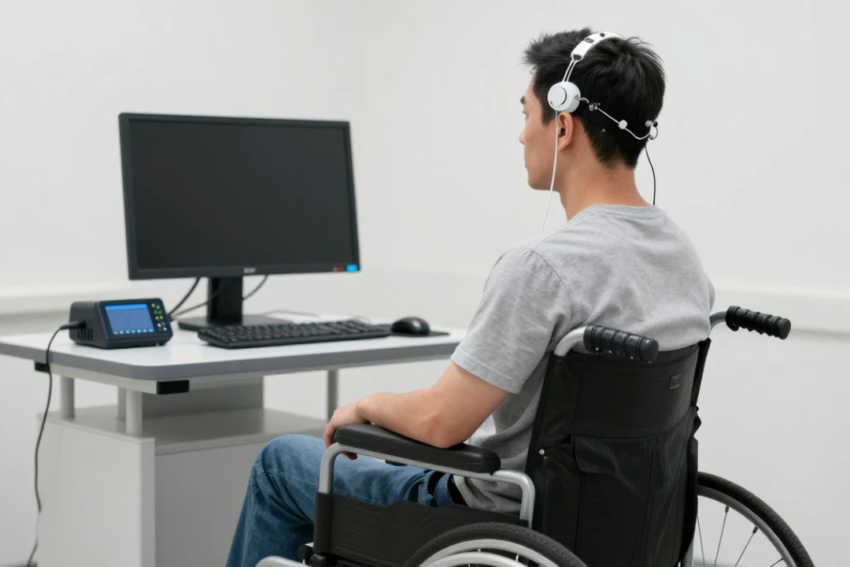
Recent advances in medical technology are beginning to change this situation. Scientists have developed brain-computer interfaces (BCIs) that can translate brain activity associated with attempted speech into words. In 2026, researchers reported an especially important development: a paralyzed man with ALS was able to use such a system independently in his own home for an extended period. The technology allowed him to communicate with family and friends, send messages and emails, use a computer, and participate in conversations.
The study, reported by the National Institutes of Health (NIH) in July 2026 and published in Nature Medicine, represents an important step in moving brain-computer interfaces from controlled laboratories toward practical everyday use. National Institutes of Health+1
What Is a Brain-Computer Interface?
A brain-computer interface is a technology that creates a direct communication pathway between brain activity and an external computer or device.
Normally, when a person wants to speak, the brain sends signals to muscles involved in producing speech. These muscles control movements of the tongue, lips, jaw, vocal cords, and other parts of the body. Diseases such as ALS can progressively weaken these muscles, eventually making speech extremely difficult or impossible.
A BCI attempts to bypass this damaged communication pathway.
Instead of relying on the muscles to produce speech, electrodes placed in the brain record neural activity. Computer algorithms then analyze those signals and determine what the person is attempting to say.
In simple terms, the process can be described as:
Brain activity → neural signals → artificial intelligence → words → synthesized speech
This approach could give people with severe paralysis a new way to communicate without requiring them to physically move their mouths or hands.
The Medical Problem: Loss of Speech
ALS is a progressive neurological disease that damages nerve cells responsible for controlling voluntary muscles. As the disease advances, people can lose the ability to move, walk, eat, and speak.
Importantly, loss of physical movement does not necessarily mean that a person’s thoughts and understanding have disappeared.
This creates a significant communication problem. Traditional assistive technologies can help, including eye-tracking systems, keyboards, communication boards, and speech-generating devices. However, these methods may become difficult to use as paralysis progresses.
For example, an eye-tracking system requires sufficient control of the eyes. Some communication systems require a person to select letters or symbols one at a time. This can make conversations slow and exhausting.
Researchers have therefore been exploring BCIs that can translate brain signals directly into language. National Institutes of Health
The Breakthrough With the 2026 Study
The latest development came from a research team led by scientists at the University of California, Davis, including Sergey Stavisky and David Brandman.
The participant, Casey Harrell, was a 45-year-old man with ALS. His thinking remained clear, but muscle weakness caused by ALS made speaking extremely difficult.
The researchers implanted electrodes into the brain’s motor cortex, an area involved in controlling movements, including movements associated with speech.
The electrodes recorded neural activity while Harrell attempted to speak. A computer system then used artificial intelligence and machine-learning techniques to translate those neural signals into words.
The system had access to a vocabulary of approximately 125,000 words and could convert the decoded information into speech using a digital version of Harrell’s voice. That voice was created using recordings made before he lost his ability to speak. National Institutes of Health
This meant that the system was not simply displaying text on a screen. It could also produce audible speech that sounded similar to the participant’s own voice.
From Laboratory to Home
One of the most important aspects of this research is where the technology was used.
Many previous BCI experiments have taken place in highly controlled laboratories, where researchers are available to adjust equipment, troubleshoot problems, and monitor participants.
The 2026 study demonstrated something more challenging: the participant could use the system at home.
During the first 280 days of the study, researchers visited Harrell’s home between two and four times each week to set up the system. Eventually, his caregivers were trained to set it up themselves.
After that, Harrell used the system almost every day.
According to the NIH, he ultimately used the BCI for more than 3,800 hours of conversations, video calls, emails, and text messages over nearly two years. National Institutes of Health
This is an important milestone because practical medical technology must work outside research laboratories. A device that functions only when scientists are present has limited usefulness. A system that can be operated independently by a patient and caregivers has much greater potential as an assistive technology.
How Artificial Intelligence Makes It Possible
Artificial intelligence is a key component of the system.
The electrodes collect patterns of electrical activity from the brain. However, these signals do not directly look like words. The computer must learn the relationship between neural activity and the speech that the participant is attempting to produce.
Machine-learning algorithms are trained using examples of brain activity associated with attempted speech.
Over time, the system becomes better at recognizing the participant’s individual neural patterns.
This is important because every person’s brain is different. A signal pattern produced by one person may not be identical to the pattern produced by another person attempting to say the same word.
The AI therefore acts as a translator between neural activity and language.
The technology can also use a large vocabulary and language-processing techniques to help interpret sequences of words. This makes it possible to move beyond simple commands and toward more natural communication.
Impressive Performance
The results of the study were significant.
Across more than 180,000 sentences, Harrell rated approximately 79% as correct or mostly correct, and he was able to correct around 13% of sentences. The researchers reported that his ability to produce longer and more accurate statements improved over time. National Institutes of Health
The peer-reviewed study provides additional detail. Over nearly two years, the participant used the BCI for more than 3,800 hours at home and communicated approximately 183,060 sentences, totaling more than 1.96 million words, at an average rate of about 56 words per minute. In formal testing, attempted speech was decoded with more than 99% word accuracy using a 125,000-word vocabulary. PubMed
These numbers demonstrate that the technology is moving beyond a short laboratory demonstration toward long-term use.
A Personalized Artificial Voice
Another remarkable feature of the technology is its ability to reproduce the participant’s own voice.
When someone loses their ability to speak, they may also lose an important part of their personal identity. A generic computer-generated voice can communicate information, but it may not sound like the person who is using it.
In Harrell’s case, recordings of his voice from before ALS affected his speech were used to create a digital voice.
The system could therefore transform decoded words into speech that resembled his original voice. This has an important emotional and social dimension.
Communication is not only about transferring information. Tone, familiarity, and personal identity can also matter greatly.
Using the Brain to Control a Computer
The technology was not limited to speech.
The participant could also use brain activity to control a computer cursor. This allowed him to perform activities such as sending emails, text messages, browsing the internet, and interacting with digital devices.
The BCI therefore served as more than a speech tool. It became a method of digital access.
For a person with severe paralysis, controlling a computer can provide greater independence. Digital communication can allow someone to contact family members, participate in work, access information, and manage everyday activities.
The researchers reported that the participant was able to sustain full-time employment while using the technology. PubMed
Why This Development Is Important
The significance of this research goes beyond one individual.
The study demonstrates that an implanted BCI can potentially remain useful over a long period while being operated in a person’s home.
This addresses one of the major challenges facing brain-computer interface research: real-world usability.
For years, researchers have demonstrated impressive BCI capabilities under controlled experimental conditions. However, patients need technologies that are reliable, practical, and useful in their daily lives.
The 2026 study provides evidence that this goal may be achievable.
Earlier Research Paved the Way
The 2026 development did not happen suddenly. It is part of years of research into speech neuroprostheses.
In 2024, researchers at UC Davis reported a speech BCI involving a 45-year-old man with ALS and severe dysarthria. The system translated his attempted speech into words and used text-to-speech technology to produce audible communication.
The system achieved 99.6% accuracy with a 50-word vocabulary on its first day of use and later achieved approximately 97.5% accuracy with a 125,000-word vocabulary after additional training. The participant communicated at approximately 32 words per minute during the study. PubMed
The 2026 research builds on this earlier work by demonstrating much longer-term, independent use at home.
This progression shows how medical technology often develops: an early proof of concept is followed by improvements in accuracy, speed, reliability, portability, and usability.
Other Advances in Brain-to-Speech Technology
The field is developing rapidly.
In 2025, another NIH-funded research team reported a brain-to-voice system for a woman who had been unable to speak following a stroke. The system translated brain activity into audible words with very low delay, producing speech in increments of approximately 80 milliseconds.
The researchers reported that the system could decode a 50-word vocabulary at approximately 90.9 words per minute and achieved more than 99% success in decoding and synthesizing speech under their experimental conditions. National Institutes of Health
Another area of research involves inner speech. Scientists are investigating whether brain-computer interfaces can decode words that a person is silently imagining rather than physically attempting to speak.
This could eventually provide another communication pathway for people who cannot move the muscles required even to attempt speech. However, it also raises important questions about privacy and ensuring that a system communicates only what a person intentionally chooses to express. National Institutes of Health
Benefits for People With Paralysis
Brain-computer speech technology could offer several important benefits.
Improved Communication
The most obvious benefit is the ability to communicate more naturally.
Instead of spelling words one letter at a time, users may be able to generate complete words and sentences directly from brain signals.
Greater Independence
A person with severe paralysis may be able to communicate without relying entirely on another person.
This can increase independence in both personal and professional environments.
Social Connection
Communication is essential for maintaining relationships.
A BCI could help people with paralysis participate more actively in conversations with family members, friends, colleagues, and caregivers.
Access to Digital Technology
The ability to control a computer could provide access to email, messaging, internet browsing, online work, and other digital services.
Preservation of Personal Identity
Personalized voice synthesis can allow users to communicate using a voice that resembles their own rather than a generic computer-generated voice.
Challenges and Limitations
Despite the promising results, the technology is still experimental and faces important challenges.
First, the current systems generally require brain surgery to implant electrodes. Surgery carries risks, and implanted medical devices must be carefully monitored.
Second, the research has involved a small number of participants. A system that works successfully for one individual cannot automatically be assumed to work equally well for everyone.
Third, the equipment remains relatively complex. Researchers are working to make future systems smaller, more durable, portable, and easier to operate.
Fourth, the technology requires training. The AI must learn to interpret the neural signals of each participant, and performance may depend on the quality and stability of those signals.
Finally, there are ethical and privacy concerns. As BCIs become more sophisticated, society will need clear rules regarding neural data, privacy, informed consent, cybersecurity, and who controls information collected from the brain.
The Future of Brain-Computer Interfaces
The future of BCI technology could extend far beyond speech.
Researchers are investigating systems that may help people with paralysis control robotic limbs, wheelchairs, computers, and other assistive technologies.
Speech BCIs may also become faster and more natural. Future systems could potentially incorporate emotional expression, changes in tone, pitch, and volume.
Researchers involved in recent work have also identified portability and durability as important goals. A future BCI could ideally be smaller, easier to maintain, and usable in more everyday environments. National Institutes of Health
Another major goal is to increase the number of people who can benefit from the technology. Larger clinical studies will be necessary to determine how well these systems work across different neurological conditions and individuals.
Ethical Considerations
As medical technology begins to interact directly with the brain, ethical questions become increasingly important.
Brain signals are deeply personal. They relate to a person’s movements, communication, and potentially aspects of cognition.
Researchers must therefore ensure that neural data is protected.
Users should also have control over when their BCI is active and what information it communicates. This is especially important as researchers explore technologies capable of decoding inner speech.
The objective should not simply be to create increasingly powerful technology. It should be to create technology that improves people’s lives while respecting autonomy, privacy, dignity, and informed choice.
Conclusion
The development of brain-computer interfaces capable of restoring communication to people with severe paralysis represents one of the most remarkable advances in modern medical technology.
The 2026 study involving a man with ALS is particularly significant because it demonstrated long-term, near-daily use of an implanted BCI in the participant’s home. The system translated attempted speech into words, produced speech using a personalized digital voice, and allowed the participant to control a computer. Over nearly two years, he used the system for more than 3,800 hours and communicated more than 1.9 million words. National Institutes of Health+1
The technology is not yet a universally available treatment, and substantial research remains necessary. However, the study represents a major shift from experimental demonstrations toward practical assistive technology.
For people who have lost the ability to speak because of ALS, stroke, or other forms of paralysis, such technology could eventually provide something extremely valuable: not simply a way to operate a machine, but a way to communicate their own thoughts, maintain relationships, participate in society, and express their identity.
Brain-computer interfaces demonstrate how artificial intelligence, neuroscience, engineering, and medicine can work together to solve problems that once seemed almost impossible. As researchers continue improving accuracy, speed, portability, and safety, brain-to-speech technology could become an important part of the future of personalized medical care and assistive communication.
The ultimate goal is simple but profound: to give people who have lost their physical ability to speak a reliable way to make their voices heard again.