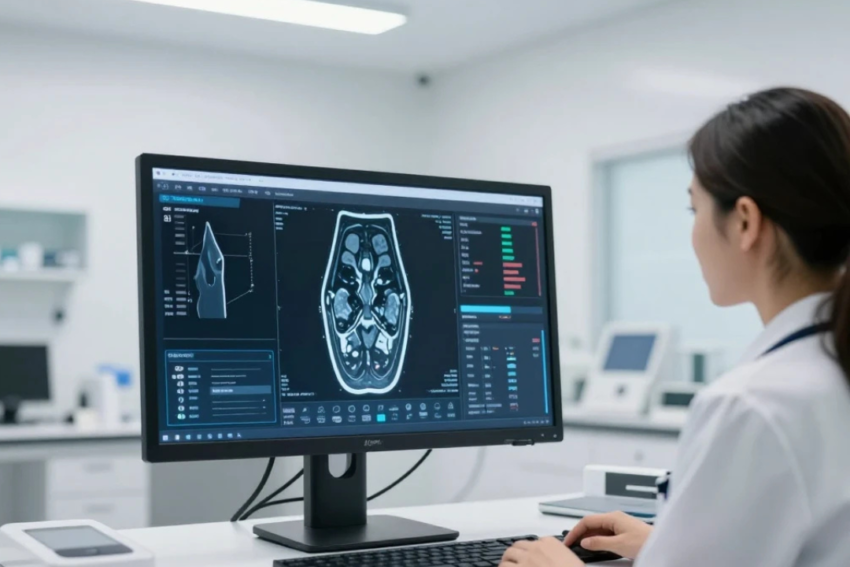
Artificial Intelligence (AI) is rapidly changing many aspects of modern life, and healthcare is one of the fields where its impact could be especially significant. Among the most promising applications of AI is disease diagnosis. Doctors traditionally rely on medical education, clinical experience, physical examinations, laboratory tests, and medical imaging to identify diseases. Today, advanced AI systems can analyze enormous amounts of medical information and identify patterns that may be difficult for humans to recognize.
This development raises an important question: Can machines detect illness better than doctors?
The answer is more complicated than simply choosing between humans and machines. AI can sometimes analyze specific types of medical data with remarkable speed and accuracy, but doctors bring experience, judgment, communication skills, and an understanding of the individual patient that machines do not possess in the same way. The future of diagnosis is therefore likely to involve cooperation between AI systems and healthcare professionals rather than one completely replacing the other.
Understanding AI-Based Diagnosis
Artificial Intelligence refers to computer systems capable of performing tasks associated with human intelligence, such as recognizing patterns, learning from information, making predictions, and processing language.
In medical diagnosis, AI systems can be trained using large collections of healthcare data. These datasets may contain medical images, laboratory results, electronic health records, genetic information, and other forms of clinical information.
Machine learning, a branch of AI, is particularly important. A machine-learning system can examine thousands or millions of examples and learn relationships between specific features and medical outcomes.
For instance, an AI system designed to analyze medical images may be trained using images that have already been reviewed by specialists. Over time, the system learns to recognize patterns associated with particular diseases. When it receives a new image, it can identify areas that appear unusual and provide a prediction for a healthcare professional to consider.
The goal is not necessarily to make the machine the final decision-maker. Instead, AI can function as an additional tool in the diagnostic process.
How AI Can Help Doctors Detect Diseases
AI can support diagnosis in several important ways.
First, it can process information extremely quickly. A doctor may need to review many medical images or patient records during a busy day. An AI system can analyze large quantities of information in a short period.
Second, AI can identify patterns. Some diseases produce subtle changes in medical images, laboratory results, or patient data. AI algorithms can be trained to recognize combinations of features that may be difficult for humans to notice consistently.
Third, AI can provide another layer of analysis. A doctor may review a scan independently, while an AI system highlights areas that deserve additional attention. This can potentially reduce the chance that an abnormality is overlooked.
AI can also help prioritize patients. If a hospital receives a large number of diagnostic images, an AI system may help identify examinations that appear urgent, allowing healthcare professionals to review potentially serious cases more quickly.
AI and Medical Imaging
Medical imaging is one of the areas in which AI has received considerable attention.
Doctors use technologies such as X-rays, CT scans, MRI scans, ultrasound, and other imaging techniques to examine the body. Interpreting these images requires extensive training and experience.
AI can analyze medical images and search for patterns associated with diseases or abnormalities. Depending on the application, it may help identify suspicious masses, fractures, bleeding, infections, or other changes.
For example, in cancer care, AI can assist specialists by examining images for characteristics that may be associated with tumors. In eye care, AI-based systems have also been researched and developed to identify signs of certain retinal diseases.
The benefit of AI is not simply speed. It can also provide consistent analysis across very large numbers of images.
However, medical images are complicated. An AI system can produce false positives, meaning it identifies something as abnormal when it is not, or false negatives, meaning it fails to identify an actual problem. This is why AI results should be evaluated by qualified healthcare professionals.
AI and Cancer Detection
Cancer is one of the most important areas of diagnostic research because early detection can significantly influence treatment options and outcomes.
AI researchers are developing systems that can assist in detecting different types of cancer from medical images and other forms of patient data.
For example, AI may examine patterns in mammograms, CT scans, pathology images, or other diagnostic materials. In pathology, computer vision systems can analyze digitized tissue samples and identify cellular features associated with disease.
AI can potentially help doctors notice suspicious areas and make diagnostic workflows more efficient.
However, cancer diagnosis is rarely based on one piece of information. Doctors often consider imaging results, laboratory tests, medical history, physical examinations, and sometimes biopsies. Therefore, AI should be viewed as one component of a larger diagnostic process.
AI and Rare Diseases
Rare diseases can be particularly difficult to diagnose. Some patients may visit multiple doctors before receiving an accurate diagnosis because their symptoms may resemble more common conditions.
AI could potentially help by comparing a patient’s symptoms and medical information against large collections of medical knowledge and patient data.
A system might identify a combination of symptoms that is unusual and suggest conditions that deserve further investigation. This could help doctors consider possibilities they might not immediately think of.
However, rare diseases also demonstrate why human expertise remains important. AI recommendations must be evaluated carefully, particularly when the available data is limited.
Can AI Be More Accurate Than Doctors?
The question of whether AI is “better” than doctors depends on what task is being measured.
For certain narrowly defined tasks, AI systems may achieve performance comparable to or better than human specialists under particular testing conditions. Computers are especially good at processing large datasets, performing repetitive calculations, and recognizing certain patterns.
Doctors, however, perform much broader tasks.
A physician does not diagnose a patient simply by looking at a single image. They may ask questions, examine the patient, review their history, consider lifestyle factors, evaluate multiple test results, and discuss concerns with the patient.
A machine may identify an abnormal pattern, but a doctor must determine what that finding means in the context of the entire patient.
Therefore, comparing AI directly with doctors may not be the most useful approach. A more meaningful question is whether doctors using AI can provide better care than doctors working without appropriate AI assistance.
This human-machine partnership may offer the greatest potential.
The Importance of Human Judgment
Medicine is not only a science; it also involves communication, ethics, uncertainty, and human relationships.
Suppose an AI system predicts that a patient has a particular disease. A doctor must still determine whether additional testing is appropriate, explain the situation to the patient, discuss possible treatments, and consider the patient’s preferences.
Doctors also deal with situations in which information is incomplete. Symptoms may not fit a textbook description, test results may conflict, or several diseases may produce similar symptoms.
Human reasoning and clinical experience remain essential in such situations.
Patients also need empathy. Being told that one might have a serious disease can be frightening. A healthcare professional can explain the situation, answer questions, provide reassurance, and help the patient make informed decisions.
AI cannot easily replace these human aspects of medicine.
The Risk of AI Errors
One of the biggest concerns about AI diagnosis is that machines can make mistakes.
AI systems learn from data. If the data used to train a system is incomplete, inaccurate, or unrepresentative, the resulting system may also have limitations.
For example, an AI system trained primarily using data from one population may not perform equally well for people from different populations. Differences in age, genetics, sex, ethnicity, healthcare access, and other factors can influence medical data.
There is also the possibility of technical errors. A poor-quality image or missing information could lead an AI system to make an incorrect prediction.
For this reason, AI systems used in healthcare require careful testing, validation, monitoring, and human oversight.
The Problem of Bias
Bias is another major challenge.
An AI system does not automatically become fair simply because it is a computer. If the data used to train it contains biases, the system can potentially reproduce or even amplify them.
For example, if certain groups are poorly represented in training data, an AI model may be less reliable for those groups.
Healthcare organizations therefore need to evaluate AI systems across different populations and clinical settings. Developers must also work to ensure that training datasets are sufficiently diverse and representative.
Reducing bias is important not only for fairness but also for patient safety.
Patient Privacy and Medical Data
AI-based diagnosis often requires large quantities of medical information. This creates important privacy concerns.
Medical records can contain highly sensitive information about a person’s health, genetics, medications, and medical history. Patients need confidence that their information will be protected.
Healthcare organizations and AI developers must therefore use appropriate security measures and follow applicable privacy and data-protection requirements.
Patients should also understand, where appropriate, how their information is being used. Responsible AI development requires more than technological innovation; it requires respect for patient rights.
AI Can Reduce Diagnostic Workloads
Doctors and medical specialists often face enormous workloads. Hospitals can receive thousands of diagnostic images and laboratory results.
AI may help reduce some of this burden by automating repetitive analysis and organizing information.
For example, an AI system could review a large collection of images and identify those that appear most likely to require urgent attention. A specialist could then focus their time on reviewing the most important cases.
This does not necessarily mean that fewer doctors are needed. Instead, it could allow doctors to spend more time on complex cases and direct patient care.
AI in Developing Healthcare Systems
AI could also play a role in expanding access to medical expertise.
Many parts of the world face shortages of doctors and medical specialists. Rural and remote communities may have limited access to advanced diagnostic services.
AI-based diagnostic tools, combined with telemedicine and appropriate medical infrastructure, could potentially assist healthcare workers in areas where specialist support is limited.
For example, a healthcare worker could use an approved AI tool to assist with the preliminary assessment of a medical image and then consult a specialist remotely.
However, technology cannot solve healthcare inequality by itself. Reliable electricity, internet connectivity, medical equipment, trained professionals, and affordable healthcare remain necessary.
The Future of AI Diagnosis
The future of AI-based diagnosis is likely to involve increasingly sophisticated systems capable of analyzing multiple forms of information simultaneously.
Instead of examining only a medical image, future systems may combine imaging, laboratory results, medical history, genetic information, and other clinical data.
This could give healthcare professionals a more comprehensive picture of a patient’s condition.
AI may also become more integrated into everyday clinical software. Rather than functioning as a separate tool, AI could work in the background and alert doctors when important patterns are detected.
However, increased capability must be accompanied by increased responsibility. Healthcare systems will need clear standards for evaluating AI tools and determining when human review is required.
Will AI Replace Doctors?
The idea that AI will completely replace doctors is often exaggerated.
AI may replace or automate certain tasks, but medicine involves much more than diagnosis. Doctors communicate with patients, perform physical examinations, interpret complex situations, make ethical judgments, coordinate care, and take responsibility for treatment decisions.
AI can assist with many of these activities, but it does not have the same human relationship with patients.
The more realistic future is therefore one in which doctors and AI systems work together. Doctors can use AI to process information and identify patterns, while AI can benefit from human oversight and clinical expertise.
In this model, technology becomes an assistant rather than a replacement.
Conclusion
Artificial Intelligence is changing the way diseases can be detected and diagnosed. It can analyze enormous quantities of medical data, identify patterns, assist with medical imaging, support cancer detection, and help healthcare professionals manage increasingly complex workloads.
In some specialized diagnostic tasks, AI can perform extremely well and may even outperform humans under certain conditions. But this does not mean that machines are generally better than doctors.
Medicine requires more than pattern recognition. It requires clinical judgment, communication, empathy, ethical reasoning, and an understanding of the individual patient.
The most promising future is therefore not AI versus doctors, but AI with doctors. When carefully designed, properly tested, and responsibly used, AI can give healthcare professionals powerful new tools for detecting disease and making informed decisions.
Ultimately, the goal of AI in medicine should not be to replace the human doctor. Its goal should be to help doctors become more accurate, efficient, and capable of providing better care to their patients. As technology continues to develop, the successful integration of human expertise and artificial intelligence could become one of the most important developments in the future of healthcare.