Introduction
Cloud computing has become one of the most influential technologies of the modern digital era. It has changed the way individuals, businesses, educational institutions, governments, and technology companies store information, run applications, process data, and deliver digital services. Today, people can access files, applications, databases, and computing resources from almost anywhere through an internet connection. However, cloud computing did not appear suddenly. It developed over several decades as computer networks, virtualization, data centers, and internet technologies continued to improve.
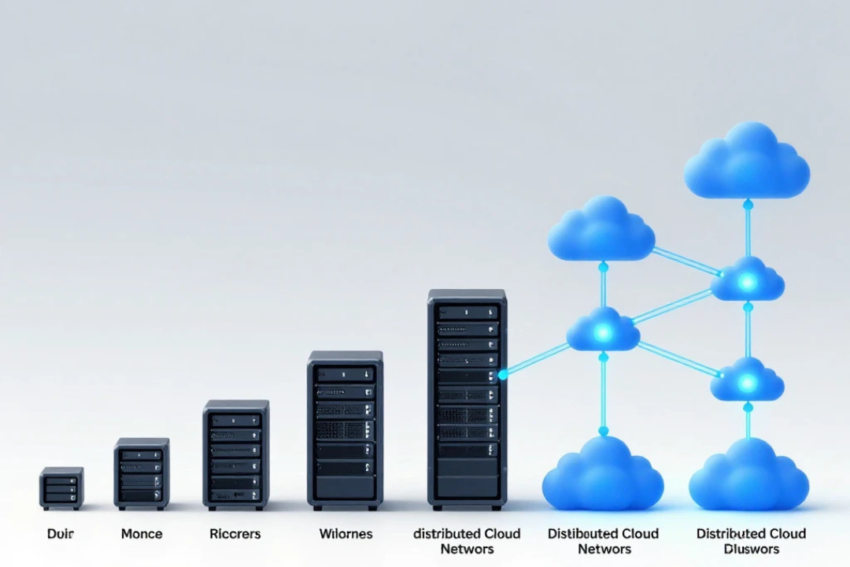
The evolution of cloud computing reflects the broader development of information technology. Early computers were large, expensive machines that could only be accessed by a limited number of users. Over time, computing became smaller, more affordable, and more connected. The development of computer networks and the internet made it possible to share resources across geographical boundaries. Later, virtualization and large-scale data centers provided the technical foundation for modern cloud platforms.
Today, cloud computing has moved beyond basic online storage and web applications. It supports artificial intelligence, machine learning, big data analytics, Internet of Things devices, software development, online entertainment, remote work, and many other technologies. Its future is expected to involve greater automation, improved security, intelligent systems, edge computing, and sustainable infrastructure.
The Early Development of Computing
To understand the evolution of cloud computing, it is important to look at the early history of computing. In the middle of the twentieth century, computers were extremely large and expensive. They occupied entire rooms and required specialized environments and trained professionals.
Organizations that needed computing capabilities had to purchase or lease expensive machines. Computing resources were therefore limited to governments, universities, research institutions, and large businesses.
One important development was time-sharing. Instead of allowing one user to control a computer for an extended period, time-sharing systems enabled multiple users to share the computing resources of a central machine. Users could interact with the system through terminals while the computer divided its processing resources among them.
Although these early systems were very different from today’s cloud platforms, the concept of sharing computing resources was an important step toward the idea that computing could be provided as a service.
The Rise of Computer Networks
The development of computer networks significantly influenced the future of cloud computing. Networks allowed computers to communicate and share resources.
As networking technologies improved, organizations began connecting computers within offices, universities, research institutions, and other environments. Local area networks made it possible to share files, printers, applications, and other resources.
The development and expansion of the internet took this concept to a much larger scale. Computers around the world could communicate with each other, making it possible to deliver digital services to users regardless of their physical location.
The internet eventually became the foundation through which modern cloud services could be accessed.
The Development of Client-Server Computing
During the development of information technology, the client-server model became widely used. In this model, users interact with client computers while servers provide centralized services such as databases, applications, and file storage.
The client-server model introduced an important separation between users and computing infrastructure. Instead of every computer independently storing and processing all information, servers could provide shared resources to multiple clients.
This model helped organizations manage their information more efficiently. However, businesses still had to purchase, operate, and maintain their own servers. As demand increased, managing physical infrastructure became increasingly expensive and complicated.
The limitations of traditional infrastructure created opportunities for new approaches to computing.
The Emergence of Virtualization
Virtualization was one of the most important technological developments in the evolution of cloud computing.
Traditionally, one physical server would often run a single operating system and a limited number of applications. Virtualization made it possible for one physical server to host multiple virtual machines. Each virtual machine could operate as if it were an independent computer.
This technology allowed organizations to use hardware more efficiently. Instead of having servers that remained underused for much of the time, computing resources could be shared among multiple virtual environments.
Virtualization also made it easier to create, modify, move, and manage computing environments. These characteristics became extremely valuable for cloud providers.
Large cloud platforms could use virtualization to divide powerful physical infrastructure into flexible resources that could be assigned to different customers.
The Growth of Data Centers
Another important stage in the evolution of cloud computing was the development of large-scale data centers.
A data center is a facility containing computing hardware, storage systems, networking equipment, power systems, cooling infrastructure, and security controls. Organizations have traditionally built data centers to operate their own IT systems.
As internet services became increasingly popular, technology companies began constructing enormous data centers capable of supporting millions of users.
These facilities could provide computing resources on a much larger scale than traditional corporate server rooms. Automated management systems could allocate resources according to demand, while redundancy and backup systems could improve reliability.
Large-scale data centers became the physical foundation of modern cloud computing.
The Beginning of Modern Cloud Computing
The modern concept of cloud computing began to develop strongly in the early twenty-first century. Technology companies started offering computing resources through the internet rather than requiring customers to purchase physical hardware.
Instead of buying a server, an organization could rent virtual computing resources. Instead of purchasing large amounts of storage, it could obtain storage according to its requirements.
This represented a major change in the traditional IT business model.
Organizations could begin with a small amount of infrastructure and increase their resources when necessary. This flexibility was particularly valuable for startups and rapidly growing businesses.
Cloud computing also reduced the importance of physical location. Users could access their services remotely as long as they had suitable network connectivity.
Major Cloud Service Models
As cloud computing developed, different service models emerged to meet different customer requirements.
Infrastructure as a Service
Infrastructure as a Service, or IaaS, provides fundamental computing infrastructure through the internet. Customers can obtain virtual machines, storage, networks, and other resources without owning the underlying physical hardware.
IaaS gives customers considerable control over their computing environments. It is useful for organizations that need flexible infrastructure for applications, websites, testing environments, and data processing.
Platform as a Service
Platform as a Service, or PaaS, provides developers with tools and environments for building and deploying applications.
With PaaS, developers do not have to manage all aspects of the underlying infrastructure. Instead, they can concentrate on writing application code while the cloud provider manages many infrastructure components.
This can accelerate software development and simplify application deployment.
Software as a Service
Software as a Service, or SaaS, provides complete software applications through the internet.
Users can access SaaS applications through web browsers or dedicated applications. The provider generally manages the infrastructure, updates, maintenance, and software deployment.
Email platforms, online collaboration systems, customer-management applications, and many office productivity tools use this model.
The Expansion of Cloud Computing
Cloud computing expanded rapidly as organizations recognized its potential benefits. Businesses could reduce infrastructure costs, improve flexibility, and access advanced technologies without building everything themselves.
Small companies benefited because they could use infrastructure that previously would have been affordable only to large organizations.
Cloud computing also supported the growth of online businesses. Companies could launch websites and applications without investing heavily in physical data centers.
The model became particularly useful for businesses with unpredictable demand. An online service might require limited computing resources under normal conditions but significantly more resources during peak periods.
Cloud infrastructure made it possible to scale resources according to changing demand.
Cloud Computing and Remote Work
Cloud computing has played an important role in the development of remote and hybrid work.
Traditional office environments often required employees to work with computers and servers located within a particular building. Cloud-based applications changed this model by allowing employees to access documents, business applications, communication platforms, and other resources remotely.
The growth of remote work demonstrated the importance of flexible digital infrastructure. Employees could collaborate with colleagues in different cities or countries while accessing many of the same resources they would use in a physical office.
Cloud technology has therefore contributed to the transformation of modern workplaces.
Cloud Computing and Artificial Intelligence
One of the most significant future developments in cloud computing is its relationship with artificial intelligence.
Artificial intelligence systems can require substantial computing power and large amounts of data. Cloud platforms can provide the processing resources needed to train and operate sophisticated AI models.
Instead of purchasing expensive specialized hardware, organizations can use cloud-based computing resources according to their requirements.
Cloud platforms can also provide ready-made AI services, allowing developers to incorporate capabilities such as language processing, image recognition, speech recognition, and predictive analytics into applications.
As AI continues to develop, cloud computing is likely to remain a major platform for delivering AI technologies.
The Rise of Edge Computing
Although cloud computing centralizes many computing resources in large data centers, the future is also likely to involve more distributed computing.
Edge computing moves some data processing closer to the devices and users that generate or consume the data. This can reduce the distance data must travel and can improve response times.
Edge computing is particularly relevant to applications that require rapid responses. Examples include autonomous systems, industrial monitoring, smart cities, connected vehicles, and certain Internet of Things applications.
Rather than replacing cloud computing, edge computing is likely to complement it. Cloud data centers can perform large-scale processing and storage, while edge devices can handle tasks that require immediate local responses.
The Future of Cloud Security
Security will remain one of the most important issues in the future of cloud computing.
As organizations store more valuable information in cloud environments, attackers may increasingly target cloud accounts, applications, and infrastructure.
Cloud providers are expected to continue improving security through technologies such as advanced encryption, automated threat detection, identity management, continuous monitoring, and artificial intelligence.
Organizations will also need to improve their own security practices. Employees must understand issues such as strong authentication, access permissions, phishing attacks, and secure data handling.
Future cloud security will likely focus increasingly on the principle of zero trust, in which users and devices are continuously evaluated rather than automatically trusted based on their network location.
Serverless Computing
Serverless computing is another important development in the evolution of cloud technology.
In traditional cloud computing, developers may still need to manage virtual machines or containers. Serverless platforms allow developers to execute application functions without directly managing the underlying servers.
The cloud provider automatically manages the required infrastructure and allocates resources according to demand.
This model can simplify application development and allow organizations to pay primarily for the computing resources their applications actually use.
Serverless computing is particularly useful for applications that experience variable or unpredictable workloads.
Sustainability and Green Cloud Computing
The increasing size of cloud data centers has also created concerns about energy consumption and environmental impact.
Data centers require electricity to operate servers, networking equipment, cooling systems, and other infrastructure. As demand for cloud services continues to increase, improving energy efficiency will become increasingly important.
Cloud providers are investing in more efficient hardware, improved cooling technologies, renewable energy, and better infrastructure management.
Green cloud computing focuses on reducing the environmental impact of cloud infrastructure while maintaining reliable services.
In the future, sustainability may become an increasingly important factor when organizations choose cloud providers.
The Future of Cloud Computing
The future of cloud computing is likely to be characterized by greater intelligence, automation, flexibility, and integration with other technologies.
Artificial intelligence may automate infrastructure management, identify performance problems, detect security threats, and optimize resource allocation.
Cloud platforms may also become increasingly specialized for areas such as machine learning, scientific computing, financial services, healthcare, and industrial applications.
Hybrid and multi-cloud strategies are also expected to remain important. Organizations may use multiple cloud providers or combine public and private infrastructure to meet different requirements.
Another important development will be improved integration between cloud and edge computing. Applications may dynamically decide where processing should occur based on factors such as speed, cost, security, and available resources.
Challenges Facing the Future
Despite its potential, cloud computing will continue to face challenges.
Data privacy will remain a major concern, particularly as governments introduce and strengthen regulations concerning personal and organizational information.
Dependence on cloud providers can also create risks. Organizations may become heavily dependent on a particular platform, making migration difficult.
The increasing complexity of cloud environments may create additional challenges for IT professionals. Managing multiple services, applications, security controls, and data sources requires specialized knowledge.
There will also be an ongoing need to balance performance, cost, security, and sustainability.
Conclusion
The evolution of cloud computing represents one of the most significant transformations in the history of information technology. From early time-sharing systems and computer networks to virtualization, large-scale data centers, and modern cloud platforms, cloud computing has developed through continuous technological innovation.
Today, cloud computing provides organizations and individuals with flexible access to computing resources. Infrastructure as a Service, Platform as a Service, and Software as a Service have changed how technology is purchased, developed, deployed, and used.
Looking ahead, cloud computing is likely to become even more closely connected with artificial intelligence, edge computing, serverless technologies, automation, and the Internet of Things. Security, privacy, and sustainability will remain critical considerations as cloud infrastructure continues to expand.
Ultimately, the future of cloud computing is not simply about moving more services to remote data centers. It is about creating a more flexible, intelligent, connected, and efficient computing environment. As technology continues to evolve, cloud computing will remain a fundamental part of the digital world and will continue to influence how people and organizations use technology in the years ahead.
If you want, I can also make this more formal and university-level, add references/citations, or format it as a complete assignment with introduction, objectives, headings, conclusion, and bibliography.