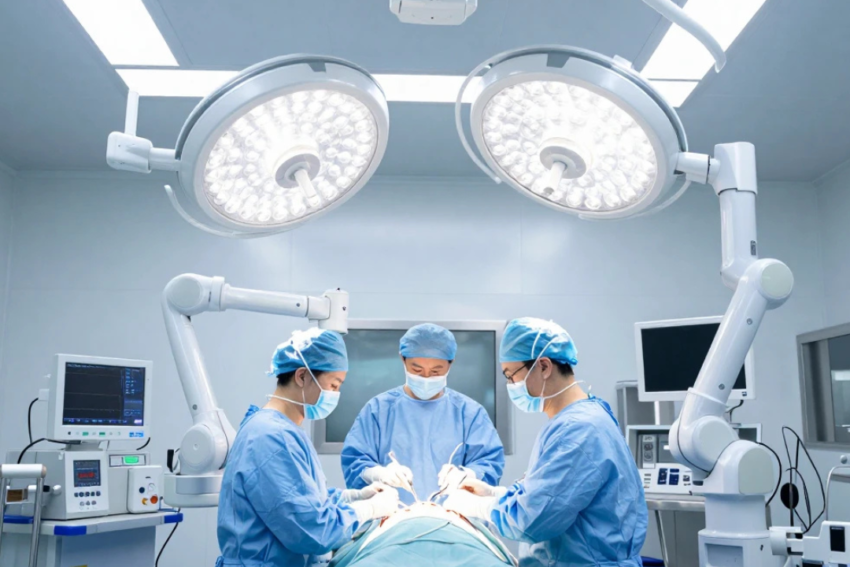
Surgery has always been one of the most demanding areas of medicine. Surgeons need years of education, training, and practical experience to perform complex procedures safely. Even with advanced medical knowledge, surgery can involve significant challenges because the human body contains delicate organs, tissues, blood vessels, and nerves that must be treated with great precision.
In recent decades, technology has transformed surgical care. One of the most exciting developments is the combination of Artificial Intelligence (AI) and robotic technology. AI-powered robotic surgery is creating new possibilities for surgeons by providing advanced visualization, precise instrument control, data analysis, and decision-support tools.
Robotic surgery does not mean that a robot independently performs an operation without human involvement. In most current systems, the surgeon remains responsible for controlling the procedure, while robotic technology provides specialized instruments and enhanced capabilities. AI can add another layer by helping analyze information, recognize patterns, and support surgical decision-making.
As these technologies continue to develop, AI-powered robotic surgery could become an increasingly important part of modern healthcare.
What Is Robotic Surgery?
Robotic surgery is a form of minimally invasive surgery in which a surgeon uses a robotic system to control specialized surgical instruments.
Instead of making a large incision, surgeons can often perform procedures through several small openings. A camera provides a magnified view of the surgical area, while robotic instruments allow precise movements inside the body.
The surgeon typically sits at a console and controls the instruments. The robotic system translates these movements into highly controlled movements of the surgical tools.
This technology can provide advantages such as enhanced visualization, precision, and flexibility.
However, robotic surgery is still surgery. It requires qualified surgeons, careful planning, appropriate patient selection, and medical teams who are trained to use the technology safely.
The Role of Artificial Intelligence
AI can make robotic surgery more sophisticated.
Traditional robotic systems primarily respond to the surgeon’s movements. AI can potentially analyze surgical images, recognize anatomical structures, monitor the progress of a procedure, and provide information that may assist the surgeon.
For example, an AI system could analyze a live surgical image and help identify particular tissues or structures. This could provide surgeons with additional information during complicated procedures.
AI may also analyze large amounts of historical surgical data to identify patterns associated with successful procedures or complications.
The objective is not necessarily to give the machine complete control. Instead, AI can function as an intelligent assistant that provides useful information while keeping the surgeon at the center of the procedure.
Greater Precision
Precision is one of the major potential advantages of robotic surgery.
Human hands are extremely capable, but even experienced surgeons can experience small movements caused by natural hand tremors or physical fatigue.
Robotic systems can filter or reduce certain unwanted movements and translate the surgeon’s actions into controlled instrument movements.
In delicate procedures, this can be particularly valuable.
AI may further enhance precision by analyzing the surgical environment and providing information about the location of important anatomical structures.
For example, during a procedure near sensitive tissue, an AI system could potentially help identify the boundaries of an important structure and alert the surgeon if the instruments approach an area of concern.
These capabilities could help surgeons perform certain complex operations with greater control.
Better Visualization
Another major advantage of robotic surgery is improved visualization.
Traditional surgery may provide surgeons with a direct view of the operating area, while minimally invasive surgery can involve working through narrow openings.
Robotic systems often use high-quality cameras that provide magnified views of the surgical field.
AI can potentially analyze these images in real time. It may help distinguish between different tissues, identify anatomical structures, or highlight areas requiring attention.
This combination of advanced imaging and AI analysis could provide surgeons with information that is difficult to obtain through ordinary visual inspection alone.
Minimally Invasive Procedures
Robotic surgery is often associated with minimally invasive techniques.
Instead of making a large incision, surgeons may be able to operate through several small incisions.
Smaller incisions can potentially result in less tissue damage, reduced blood loss, less postoperative discomfort, and faster recovery for certain procedures.
However, the benefits depend on the specific operation, the patient’s condition, and the surgeon’s expertise. Robotic surgery is not automatically better for every patient or every procedure.
The technology is most useful when its capabilities match the needs of the operation.
AI in Surgical Planning
AI can assist not only during surgery but also before it begins.
Before an operation, surgeons need to understand the patient’s anatomy and determine the best approach.
Medical imaging such as CT scans and MRI scans can provide detailed information about the patient’s body.
AI can analyze these images and potentially create detailed anatomical models. Surgeons can use these models to study the patient’s anatomy and plan the procedure.
This could be especially useful when anatomy is complex or when a tumor or other abnormality is located near important structures.
Better planning may allow surgical teams to anticipate challenges before entering the operating room.
AI During Operations
During an operation, AI can potentially act as a real-time assistant.
It may analyze video from surgical cameras and recognize different stages of a procedure.
For example, if a procedure follows a series of standard steps, an AI system could identify which stage the surgeon is currently performing and provide relevant information.
AI could also monitor surgical instruments and help track their positions.
In the future, these capabilities might enable systems to provide warnings when unusual patterns occur or when a surgical action appears inconsistent with the planned procedure.
Such systems would need extensive testing before being trusted in real clinical environments.
AI and Surgical Training
Another important application is medical education and surgical training.
Becoming a skilled surgeon requires extensive practice. Traditionally, surgeons learn through medical education, simulations, supervised procedures, and real-world experience.
Robotic surgical platforms can provide realistic environments in which trainees can practice specific techniques.
AI can analyze trainee performance and provide feedback.
For example, an AI system could evaluate movements, instrument control, efficiency, and other measurable aspects of a procedure.
This could help trainees identify areas where they need improvement.
Simulation-based training can also allow surgeons to practice difficult procedures without putting patients at risk.
Remote Surgery
Robotic technology has also raised the possibility of remote surgery.
In theory, a surgeon could control a robotic system from a different location, provided that the necessary technology, communication infrastructure, and safety systems are available.
This could potentially allow specialists to assist patients in locations where particular surgical expertise is not locally available.
However, remote surgery presents significant technical challenges. Communication delays, network failures, cybersecurity threats, equipment problems, and emergency situations all need to be addressed.
Therefore, widespread remote robotic surgery requires extremely reliable infrastructure and strict safety standards.
Applications in Different Medical Fields
Robotic surgery is being explored or used across various specialties.
Urology
Robotic systems have been used extensively in certain urological procedures. Surgeons can benefit from precise instrument control and enhanced visualization when operating in anatomically complex areas.
Gynecology
Robotic technology can assist with certain gynecological procedures, particularly operations that require precise movements in confined spaces.
General Surgery
Some abdominal procedures can be performed using robotic systems, depending on the patient’s condition and the surgeon’s expertise.
Cardiac Surgery
Robotic technology has also been explored for certain heart procedures where precise movements and minimally invasive approaches may be beneficial.
Cancer Surgery
Robotic systems can assist surgeons in removing tumors while attempting to preserve surrounding healthy tissue. AI may potentially provide additional assistance by analyzing medical images and identifying anatomical structures.
The usefulness of robotic technology varies significantly between procedures.
Benefits for Patients
The potential benefits of AI-powered robotic surgery include greater surgical precision, enhanced visualization, minimally invasive techniques, and improved surgical planning.
For some procedures, these advantages may contribute to reduced recovery times or fewer complications.
Patients may also benefit from more personalized surgical planning. AI can analyze individual medical images and patient information to help surgeons understand the specific anatomy of each patient.
However, patients should not assume that robotic surgery is automatically safer or more effective than conventional surgery. The appropriate surgical method depends on many factors.
Challenges and Limitations
Despite its promise, AI-powered robotic surgery has significant limitations.
One major challenge is cost. Robotic surgical systems can be expensive to purchase, maintain, and operate. Hospitals need substantial resources and trained staff to use them effectively.
Another issue is training. Surgeons cannot simply begin using a robotic system without specialized training. They need to understand both the surgical procedure and the technology.
There is also the possibility of technical failure. Robotic systems are complex machines, and equipment malfunction could create serious problems during surgery. Hospitals therefore need backup procedures and emergency protocols.
AI systems can also make incorrect predictions. An algorithm may misinterpret an image or incorrectly identify a structure.
For this reason, AI should not be treated as infallible.
Ethical and Safety Concerns
The introduction of AI into surgery creates important ethical questions.
One concern is responsibility. If an AI system provides an incorrect recommendation that contributes to a surgical complication, who should be held responsible?
Another issue is transparency. Surgeons need to understand the capabilities and limitations of the AI tools they use.
Patient privacy is also important. AI systems may require access to medical images, surgical recordings, and other sensitive information.
Hospitals and technology developers must protect this information and use it responsibly.
Patient consent is another consideration. Patients should receive appropriate information about the technology being used in their care and understand that robotic surgery still involves risks.
Will Robots Replace Surgeons?
One of the most common fears surrounding robotic surgery is that robots will eventually replace human surgeons.
This is unlikely to be the most useful way to understand the technology.
Surgery involves much more than moving instruments. Surgeons must evaluate patients, make decisions under uncertain conditions, respond to unexpected complications, communicate with patients and families, and work with the wider medical team.
These responsibilities require judgment and human expertise.
AI-powered robotic systems are more likely to become sophisticated assistants rather than completely independent surgeons.
In the future, certain repetitive or highly standardized surgical tasks might potentially be automated under strict supervision. However, complex medical decision-making will continue to require human involvement.
The Future of AI-Powered Robotic Surgery
The future could involve increasingly intelligent robotic systems.
AI may become better at recognizing anatomy, predicting surgical steps, analyzing tissue, and providing real-time recommendations.
Robotic systems could potentially use patient-specific models created from medical imaging to help surgeons plan and execute procedures.
Another possibility is increased automation of certain routine surgical tasks. However, such developments would require extensive research, testing, regulation, and ethical consideration.
Future systems may also become smaller, more affordable, and more accessible to hospitals.
As technology improves, the focus will likely shift from simply creating more advanced machines to determining how these machines can safely improve patient outcomes.
The Importance of Human-Machine Cooperation
The greatest potential of AI-powered robotic surgery may come from cooperation between humans and machines.
Robots are good at precise mechanical movements. Computers are good at analyzing large amounts of data. AI can identify patterns and provide predictions.
Humans, meanwhile, are capable of empathy, flexible reasoning, ethical judgment, and understanding the patient’s individual needs.
Combining these strengths could create a powerful surgical partnership.
The surgeon would remain responsible for major decisions while AI and robotic systems provide technical assistance and additional information.
This approach could allow surgeons to perform complicated procedures with better tools while maintaining human oversight.
Conclusion
AI-powered robotic surgery represents an exciting development in modern medicine. By combining robotics, advanced imaging, artificial intelligence, and human surgical expertise, these systems can provide new possibilities for precision, planning, training, and minimally invasive treatment.
AI can assist surgeons by analyzing medical images, recognizing anatomical structures, monitoring surgical procedures, and providing decision-support information. Robotic systems can provide precise instrument control and enhanced visualization.
However, the technology also has limitations. High costs, training requirements, technical failures, privacy concerns, algorithmic errors, and ethical questions must all be addressed.
Most importantly, robotic surgery should not be viewed as a battle between humans and machines. The future of surgery is more likely to involve humans working alongside intelligent machines.
AI-powered robotic systems may become increasingly capable, but surgeons will continue to play a central role in patient care. Their experience, judgment, communication, and responsibility cannot simply be replaced by technology.
If developed and implemented responsibly, AI-powered robotic surgery could make certain procedures more precise, efficient, and personalized. It has the potential to become an important part of the future of surgical care—not by replacing surgeons, but by giving them better tools to care for their patients.