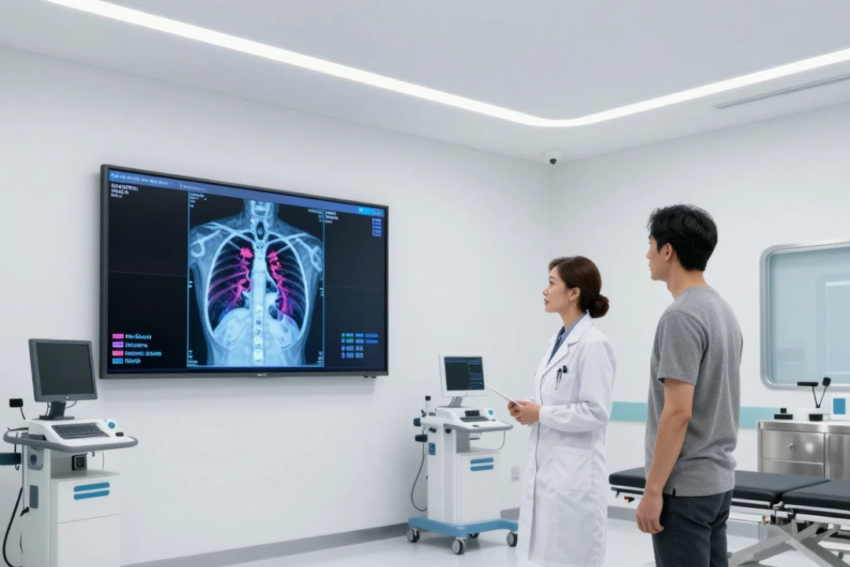
Artificial Intelligence (AI) has become one of the most influential technologies of the modern era. From smartphones and online shopping to transportation and finance, AI is changing the way people live and work. One of the areas where its impact is particularly significant is healthcare. Artificial Intelligence is increasingly being used to assist doctors, analyze medical information, discover new medicines, monitor patients, and improve the overall delivery of healthcare services.
Healthcare has always depended on human knowledge, experience, and decision-making. Doctors, nurses, surgeons, researchers, and other healthcare professionals make thousands of important decisions every day. However, the growing amount of medical information and the increasing demand for healthcare services have created challenges that traditional systems cannot always handle efficiently. AI offers new tools that can help healthcare professionals process information faster and make more informed decisions.
AI is not designed to replace doctors or other healthcare workers. Instead, its greatest potential lies in supporting them. When used responsibly, AI can help medical professionals spend less time on repetitive tasks and more time caring for patients. It can also make healthcare more accessible, personalized, and efficient.
What Is Artificial Intelligence in Healthcare?
Artificial Intelligence refers to computer systems that can perform tasks that normally require human intelligence. These tasks may include recognizing patterns, understanding language, learning from information, making predictions, and supporting decision-making.
In healthcare, AI systems can analyze large amounts of medical data, including patient records, laboratory results, medical images, genetic information, and information from wearable devices. Machine learning, a major branch of AI, allows computer systems to identify patterns in data and improve their performance through experience.
For example, an AI system may be trained using thousands of medical images. After learning from these examples, it may be able to identify certain patterns associated with a disease and highlight areas that require a doctor’s attention.
This does not mean that the computer independently becomes a doctor. Rather, it acts as a powerful tool that can assist medical professionals in analyzing information.
AI and Early Disease Detection
One of the most promising applications of AI in healthcare is disease detection. Early diagnosis can be extremely important because many diseases are easier to treat when they are discovered at an early stage.
AI can analyze medical images such as X-rays, CT scans, MRI scans, and other diagnostic images. Some AI systems are capable of identifying patterns that may be difficult or time-consuming for humans to detect.
For example, AI-based tools can assist healthcare professionals in examining medical images for signs associated with certain cancers, lung conditions, eye diseases, and other illnesses. The technology can highlight suspicious areas, allowing specialists to investigate them more carefully.
AI can also analyze combinations of information rather than relying on a single test. A patient’s age, medical history, laboratory results, symptoms, and other information can potentially be analyzed together to help identify patterns associated with a particular condition.
The major advantage is speed and scale. A computer can process enormous quantities of information in a short period of time. However, AI results still need appropriate clinical oversight because incorrect predictions or overlooked information can have serious consequences.
Personalized Healthcare
Another major way AI is transforming healthcare is through personalized medicine. Traditionally, medical treatment has often followed general guidelines based on groups of patients. However, individuals can respond differently to the same treatment.
AI can help researchers and healthcare professionals analyze information about individual patients and identify factors that may influence treatment outcomes. Genetic information, medical history, lifestyle, medications, and other factors can potentially be considered when developing a treatment strategy.
This approach may help healthcare move toward a future in which treatments are increasingly tailored to individual patients.
For example, researchers can use AI to analyze large datasets and search for patterns indicating which treatments may work better for particular groups of patients. This can support clinical decision-making and research into more targeted therapies.
Personalized healthcare does not mean that AI makes treatment decisions independently. Instead, it can provide additional information that doctors can consider alongside their professional knowledge and the patient’s individual circumstances.
AI in Drug Discovery
Developing a new medicine can be an extremely long and expensive process. Researchers need to identify promising compounds, study their effects, test their safety, and conduct clinical trials before a medicine can become widely available.
AI is helping researchers explore this process more efficiently. It can analyze large databases of biological and chemical information and identify relationships that might otherwise take researchers much longer to discover.
AI can help predict how particular molecules might interact with biological targets. It can also assist researchers in identifying potentially promising drug candidates and narrowing down the number of compounds that require further investigation.
This could potentially reduce the time spent on early-stage drug discovery. However, AI-generated predictions must still be tested through laboratory research and clinical studies. A computer model cannot replace the rigorous safety and effectiveness testing required for medical treatments.
AI-Powered Medical Assistants and Chatbots
Artificial Intelligence is also changing the way patients interact with healthcare systems. AI-powered chatbots and virtual assistants can answer basic health-related questions, provide general information, help patients navigate healthcare services, and remind them about appointments or medications.
These systems can be especially useful for administrative tasks. Instead of calling a healthcare facility for simple questions, patients may be able to obtain basic information through an automated system.
AI assistants can also support healthcare workers by handling repetitive administrative responsibilities. For example, they may help organize information, summarize documents, or assist with scheduling.
However, there is an important limitation. AI systems should not be treated as a substitute for professional medical diagnosis or emergency care. Health information can be complex, and an AI system may misunderstand symptoms or provide an inappropriate response. Human medical professionals remain essential, particularly when decisions are complicated or potentially life-threatening.
AI in Robotic Surgery
Robotic technology combined with AI is creating new possibilities in surgery. Surgical robotic systems can provide surgeons with highly precise instruments and enhanced visualization.
In robotic-assisted surgery, the surgeon generally remains in control while the robotic system translates the surgeon’s movements into precise actions. Advanced technologies can help improve dexterity and provide detailed views of the surgical area.
AI may contribute by analyzing surgical data, recognizing patterns, and supporting surgeons during procedures. Future developments could make surgical systems increasingly capable of providing real-time assistance.
Nevertheless, surgery remains a highly specialized field that requires human expertise. Robots and AI systems must be carefully controlled and validated before being used in clinical environments.
Remote Patient Monitoring
Wearable technology has become another important source of health information. Smartwatches and other wearable devices can collect information such as heart rate, activity levels, sleep patterns, and other measurements.
AI can analyze this continuous stream of information and identify unusual patterns. For patients with certain chronic conditions, remote monitoring may allow healthcare professionals to receive information without requiring the patient to visit a hospital or clinic as frequently.
This can be particularly valuable for elderly patients and people who live far from medical facilities. Remote monitoring can also support more continuous healthcare rather than relying exclusively on occasional appointments.
At the same time, wearable data must be interpreted carefully. Not every unusual measurement indicates a medical problem, and inaccurate readings can cause unnecessary concern. Professional evaluation remains important.
Reducing Administrative Work
Healthcare professionals spend a significant amount of time completing paperwork and administrative tasks. These responsibilities can reduce the amount of time available for direct patient care.
AI can help automate certain repetitive processes. It can assist with documentation, appointment scheduling, data organization, medical coding, and information retrieval.
For example, AI-powered speech recognition systems can convert conversations into written notes, potentially reducing the amount of manual documentation required by healthcare professionals.
Reducing administrative burdens could improve efficiency and help healthcare workers focus more attention on patients. However, automated documentation must be reviewed for accuracy because errors in medical records can have serious consequences.
Improving Access to Healthcare
One of the most important potential benefits of AI is its ability to expand access to healthcare. In many parts of the world, there are not enough doctors, specialists, diagnostic facilities, or other healthcare resources to meet demand.
AI-powered tools may help healthcare professionals provide support in areas where specialized expertise is limited. For example, an AI system could assist a general healthcare worker in analyzing medical images or identifying patients who may require further examination by a specialist.
Telemedicine combined with AI could also allow patients in remote areas to access certain healthcare services without traveling long distances.
However, technology alone cannot solve all healthcare inequality. Reliable internet access, medical infrastructure, trained professionals, affordable treatment, and appropriate regulation are also necessary.
Challenges and Ethical Concerns
Despite its enormous potential, AI in healthcare also creates important challenges.
One major concern is patient privacy. Medical information is highly sensitive. AI systems often require large amounts of data, so healthcare organizations must ensure that patient information is properly protected.
Another concern is bias. If an AI system is trained using incomplete or unrepresentative data, it may perform better for some groups of patients than others. This could contribute to unequal healthcare outcomes.
There is also the issue of accountability. If an AI system makes an incorrect recommendation, it can be difficult to determine who is responsible. Healthcare organizations, technology developers, regulators, and medical professionals must establish clear standards for the use of AI.
Transparency is another challenge. Some AI systems can be difficult to understand because their decision-making processes are complex. Doctors and patients may need explanations of why an AI system produced a particular recommendation.
Finally, there is the risk of overdependence on technology. AI should support human judgment rather than eliminate it. Medical professionals need to understand the limitations of AI and remain responsible for appropriate clinical decisions.
The Future of AI in Healthcare
The future of AI in healthcare is likely to involve closer cooperation between humans and machines. AI systems may become better at analyzing medical information, identifying patterns, supporting research, and automating routine tasks.
Healthcare professionals, meanwhile, will continue to provide something technology cannot easily reproduce: human understanding, empathy, communication, ethical judgment, and the ability to consider the unique circumstances of individual patients.
Future healthcare systems may use AI throughout the patient journey. A person could receive assistance with scheduling an appointment, undergo AI-supported diagnostic testing, receive a personalized treatment plan developed with the help of data analysis, and be monitored remotely after treatment.
However, the success of this future will depend not only on technological progress but also on responsible implementation. Governments, hospitals, technology companies, researchers, and medical professionals must work together to establish appropriate safety standards and protect patients’ rights.
Conclusion
Artificial Intelligence is transforming modern healthcare in many ways. It is helping medical professionals analyze information, support disease detection, discover potential medicines, monitor patients, improve surgical procedures, and reduce administrative workloads.
The technology offers significant opportunities to make healthcare faster, more efficient, personalized, and accessible. At the same time, AI introduces serious concerns involving privacy, bias, accuracy, accountability, and patient safety.
The most realistic vision of the future is not one in which machines replace doctors. Instead, it is a healthcare system in which AI and medical professionals work together. Computers can process enormous amounts of information and identify patterns at remarkable speed, while healthcare professionals provide experience, compassion, judgment, and human connection.
AI therefore represents not simply a technological change but a potential transformation in how healthcare is delivered. If developed and used responsibly, it can become a powerful tool for improving medical care and helping healthcare systems meet the challenges of the future.