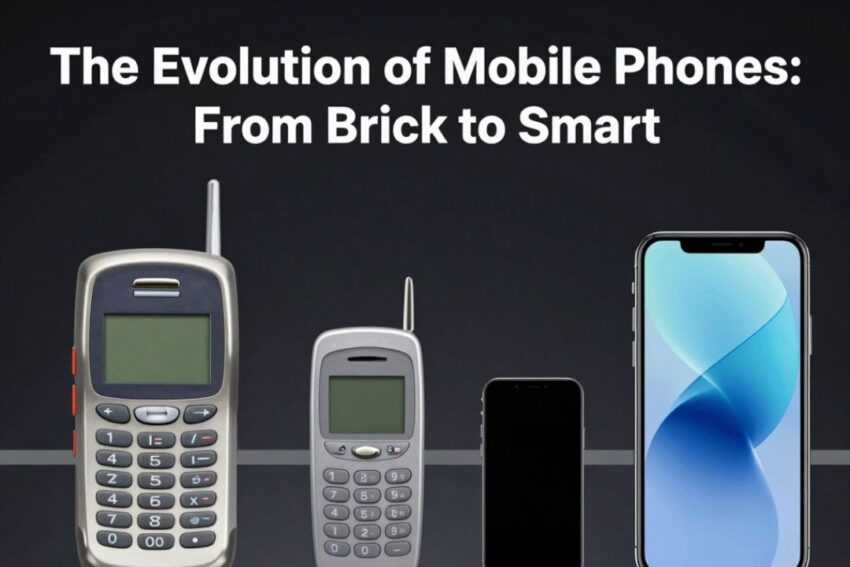
Mobile phones have transformed dramatically over the past few decades. What started as a bulky communication device for the elite has evolved into an indispensable part of everyday life, putting powerful computing capabilities into our pockets. This journey, from the early “brick” phones to today’s advanced smartphones, reflects not only technological innovation but also the changing way humans connect and interact with the world.
The Birth of Mobile Communication
The history of mobile phones begins in the 1970s. The first commercial mobile phone, the Motorola DynaTAC 8000X, launched in 1983, weighed nearly 2.5 pounds and offered just 30 minutes of talk time. Often referred to as a “brick phone” because of its size and shape, it was far from portable by today’s standards. However, this innovation represented a major breakthrough: for the first time, people could communicate without being tethered to a landline.
During this era, mobile phones were considered luxury items. They were expensive, and their use was mostly limited to business executives and high-profile individuals. Networks were also primitive; analog signals dominated, resulting in low call quality and limited coverage. Despite these limitations, the foundations for mobile communication were set, paving the way for rapid technological advancements in the decades to come.
The 1990s: The Rise of Feature Phones
The 1990s saw a significant shift in mobile technology. Phones became smaller, lighter, and more affordable. Companies like Nokia, Ericsson, and Motorola began producing models that could fit comfortably in a pocket. These phones, often called feature phones, focused on voice calls and SMS messaging but introduced additional functionalities such as simple games (remember Snake on Nokia?), alarm clocks, calculators, and rudimentary calendars.
The era also marked the transition from analog to digital networks, specifically GSM (Global System for Mobile Communications). This change improved call quality, security, and network capacity. By the mid-1990s, mobile phones were no longer luxury items—they were becoming a mainstream necessity.
Early 2000s: The Dawn of Smartphones
The term “smartphone” started gaining traction in the early 2000s. Devices such as the BlackBerry and Palm Treo were among the first to combine mobile calling with email, calendar, and basic internet capabilities. These phones were particularly popular among business professionals, thanks to their email integration and productivity tools.
However, early smartphones had limitations. Small screens, low-resolution displays, and limited app ecosystems restricted their appeal to the general consumer. Despite these challenges, they represented a crucial step toward the modern smartphones we use today.
2007: The Game-Changer – Apple iPhone
The real revolution in mobile phones came in 2007 when Apple introduced the iPhone. Unlike previous smartphones, the iPhone offered a large touchscreen, intuitive interface, and an integrated ecosystem of apps. Users could not only call and text but also browse the internet, take photos, and use software applications seamlessly.
The introduction of the iPhone marked a paradigm shift in mobile technology. It set new standards for design, functionality, and user experience. Competitors quickly adapted, and the smartphone market exploded, giving rise to an era where mobile devices were no longer just communication tools—they became personal assistants, entertainment centers, and essential lifestyle gadgets.
Android vs. iOS: The Smartphone Wars
After the iPhone’s success, Google launched Android, an open-source operating system, in 2008. Android allowed multiple manufacturers, including Samsung, Huawei, and LG, to produce smartphones with diverse features, sizes, and price points. The rivalry between Android and iOS became the defining feature of the smartphone era, fostering rapid innovation and giving consumers a wide range of choices.
Today, Android dominates global market share due to its affordability and customization options, while iOS maintains a loyal user base with its premium design, security features, and app ecosystem. This competition has accelerated the development of high-performance processors, high-resolution cameras, and innovative software features.
Modern Smartphones: Beyond Communication
Modern smartphones are nothing short of mini-computers. They integrate multiple technologies, including:
- High-resolution cameras with advanced photography and video capabilities
- Powerful processors capable of running complex applications and games
- AI-powered assistants like Siri, Google Assistant, and Bixby
- Biometric security such as facial recognition and fingerprint scanners
- 5G connectivity for faster internet speeds and seamless streaming
Additionally, smartphones now serve as hubs for smart homes, fitness tracking, mobile banking, social networking, and even augmented reality experiences. The mobile phone has truly become an extension of daily life.
The Role of Mobile Phones in Society
The evolution of mobile phones has reshaped how people communicate, work, and access information. Social media platforms, instant messaging apps, and video calling have connected the world in ways previously unimaginable. Businesses leverage mobile technology for marketing, customer engagement, and remote operations. Educational institutions have adopted mobile learning tools, and healthcare providers use smartphones for telemedicine and patient monitoring.
Mobile phones have also influenced culture, fashion, and entertainment. Limited only by imagination, app developers continue to create experiences that transform the way we live, work, and play.
The Future: What’s Next for Mobile Phones?
The journey from brick phones to smartphones is ongoing. Emerging technologies promise to further revolutionize mobile devices:
- Foldable and rollable displays are redefining device form factors.
- AI-driven features will make phones smarter in predicting user needs.
- AR and VR integration could transform gaming, shopping, and education.
- Eco-friendly materials and sustainable production practices are gaining importance.
As 5G networks expand, smartphones will become even more powerful, enabling real-time collaboration, immersive experiences, and ultra-fast communication. The line between smartphones and other computing devices will continue to blur, making mobile phones an even more central part of human life.
Conclusion
The evolution of mobile phones from bulky brick devices to sleek, multifunctional smartphones is a testament to human innovation and the relentless pursuit of connectivity. Today, mobile phones are far more than tools for communication—they are portals to the digital world, personal assistants, entertainment hubs, and lifelines in emergencies.
Understanding this journey not only highlights the technological advancements of the past decades but also gives a glimpse into a future where mobile phones will continue to transform the way we live, work, and interact.
Keywords for SEO: mobile phones, smartphone evolution, mobile technology, feature phones, iPhone, Android smartphones, 5G smartphones, mobile communication, modern smartphones
If you want, I can also create a fully formatted version with headings, meta description, and SEO tags ready for a blog post, which will make it even more search-engine-friendly.
Do you want me to do that next?